China's Cyber-Militia (National Journal, 31 May 2008)Computer hackers in China, including those working on behalf of the Chinese government and military, have penetrated deeply into the information systems of U.S. companies and government agencies, stolen proprietary information from American executives in advance of their business meetings in China, and, in a few cases, gained access to electric power plants in the United States, possibly triggering two recent and widespread blackouts in Florida and the Northeast, according to U.S. government officials and computer-security experts.
One prominent expert told National Journal he believes that China’s People’s Liberation Army played a role in the power outages. Tim Bennett, the former president of the Cyber Security Industry Alliance, a leading trade group, said that U.S. intelligence officials have told him that the PLA in 2003 gained access to a network that controlled electric power systems serving the northeastern United States. The intelligence officials said that forensic analysis had confirmed the source, Bennett said. “They said that, with confidence, it had been traced back to the PLA.” These officials believe that the intrusion may have precipitated the largest blackout in North American history, which occurred in August of that year. A 9,300-square-mile area, touching Michigan, Ohio, New York, and parts of Canada, lost power; an estimated 50 million people were affected.
Officially, the blackout was attributed to a variety of factors, none of which involved foreign intervention. Investigators blamed “overgrown trees” that came into contact with strained high-voltage lines near facilities in Ohio owned by FirstEnergy Corp. More than 100 power plants were shut down during the cascading failure. A computer virus, then in wide circulation, disrupted the communications lines that utility companies use to manage the power grid, and this exacerbated the problem. The blackout prompted President Bush to address the nation the day it happened. Power was mostly restored within 24 hours.
30 May 2008
US power blackouts: a hacker connection?


Photo gallery: Uncontacted Amazonian tribe photographed
Members of an unknown Amazon Basin tribe and their dwellings are seen during a flight over the Brazilian state of Acre along the border with Peru in this May, 2008 photo distributed by FUNAI, the government agency for the protection of indigenous peoples. Survival International estimates that there are over 100 uncontacted tribes worldwide, and says that uncontacted tribes in the region are under increasing threat from illegal logging over the border in Peru.
29 May 2008
The last days of Bear Stearns
With Rupert Murdoch’s ownership, I’m not sure WSJ is going in a direction that I want to follow. So I’ve recently subscribed (as an experiment) to the Financial Times, to assure myself of a steady stream of actionable news about business. Still too early to tell, but so far so good.
The links below are a reminder that the WSJ still does some things better than anybody else: it’s a three-part series, by Kate Kelly, that ran late this month on the final days of Bear Stearns as a business.
- Lost Opportunities Haunt Final Days of Bear Stearns (WSJ, 27 May 2008)
- Fear, Rumors Touched Off Fatal Run on Bear Stearns (WSJ, 28 May 2008)
- Bear Stearns Neared Collapse Twice in Frenzied Last Days (WSJ, 29 May 2008)
Twelve hours after agreeing to sell Bear Stearns Cos. for $2 a share, Alan Schwartz wearily made his way to the company gym for a much-needed workout.
It was 6:45 a.m., March 17, and Bear Stearns's chief executive had slept little since hammering out the ugly details of his fire-sale deal with J.P. Morgan Chase & Co.
When Mr. Schwartz, already dressed in his business suit, trudged into the locker room, Alan Mintz, still in his sweaty gym clothes, made a beeline for the boss.
"How could this happen to 14,000 employees?" demanded the 46-year-old senior trader, thrusting his face uncomfortably close to Mr. Schwartz's. "Look in my eyes, and tell me how this happened!"
Two and a half months later, Mr. Schwartz still isn't quite sure. To Mr. Mintz and others, he has blamed a market tsunami he didn't see coming. He told a Senate committee last month: "I just simply have not been able to come up with anything, even with the benefit of hindsight, that would have made a difference."
28 May 2008
Retour du fils du grand saut
A misfired fuse about the size of a pen thwarted a French daredevil's third attempt to skydive from space, his team says.
When Michel Fournier's massive helium balloon launched without him early Tuesday morning, the launch team said a "freak accident" caused some equipment to strike the ground.
That triggered a small explosion and separated the balloon from the capsule and its parachutes, spokeswoman Francine Gittins told a room packed with reporters and Fournier's supporters late Tuesday afternoon.
Balloon takes off without daredevil, Calgary Herald, 28 May 2008
The sentimental mainstay of a million down-market karaoke bars
Jerome White Jr., born and raised in Pittsburgh, PA, is an unlikely enka star in Japan:
A Far Cry From Home (Washington Post, 28 May 2008)...[t]hanks to the records, videos and cassette tapes played by his Japanese-born grandmother... he got hooked on a melodramatic genre of Japanese folk balladry called enka. With no idea what the lyrics meant, he started singing it in fractured Japanese when he was 5.
As far as anybody in the music industry knows, Jero is the first African American to sing this shamelessly maudlin music for a living. Enka wallows in heartache. Accompanied by over-the-top orchestration, it is usually sung by an aging Japanese performer (male or female) in a kimono. Suicide is nearly always a viable option in its ballads of unrequited love, hopeless love, cheating love and relentless rain.
Enka became popular as a bathetic balm for the hard years that followed World War II. The Japanese sponged it up as they rebuilt their country into an industrial colossus. Enka was the sentimental mainstay of a million down-market karaoke bars. Until Jero burst upon the popular music scene here in February, it was also a musical genre that had lost much of its buzz. It had the unhip odor of Elvis ballads in his years of white jumpsuits and belly fat. Most of the people who sang enka were double or triple Jero's age, as were most of the people who listened to it.
A good question
Why Rivals Don't Copy Southwest's Hedging (Wall Street Journal, 28 May 2008)With oil near $130 a barrel, why does Southwest Airlines stand alone in the airline industry in its aggressive use of hedging to keep fuel costs under control?
Southwest has locked in more than 70% of its jet-fuel requirements this year at a price equivalent to $51 a barrel for crude oil. By contrast, other big carriers have hedged 30% or less of their fuel needs this year. Those carriers generally expect to pay the equivalent of $85 to $100 per barrel of oil under their hedging programs.
There are some good attempts at an answer in the linked article.
26 May 2008
In The Air
How useful is it to have a group of really smart people brainstorm for a day? When Myhrvold started out, his expectations were modest. Although he wanted insights like Alexander Graham Bell’s, Bell was clearly one in a million, a genius who went on to have ideas in an extraordinary number of areas—sound recording, flight, lasers, tetrahedral construction, and hydrofoil boats, to name a few. The telephone was his obsession. He approached it from a unique perspective, that of a speech therapist. He had put in years of preparation before that moment by the Grand River, and it was impossible to know what unconscious associations triggered his great insight. Invention has its own algorithm: genius, obsession, serendipity, and epiphany in some unknowable combination. How can you put that in a bottle?But then, in August of 2003, I.V. held its first invention session, and it was a revelation. “Afterward, Nathan kept saying, ‘There are so many inventions,’ ” Wood recalled. “He thought if we came up with a half-dozen good ideas it would be great, and we came up with somewhere between fifty and a hundred. I said to him, ‘But you had eight people in that room who are seasoned inventors. Weren’t you expecting a multiplier effect?’ And he said, ‘Yeah, but it was more than multiplicity.’ Not even Nathan had any idea of what it was going to be like.”
The original expectation was that I.V. would file a hundred patents a year. Currently, it’s filing five hundred a year. It has a backlog of three thousand ideas. Wood said that he once attended a two-day invention session presided over by Jung, and after the first day the group went out to dinner. “So Edward took his people out, plus me,” Wood said. “And the eight of us sat down at a table and the attorney said, ‘Do you mind if I record the evening?’ And we all said no, of course not. We sat there. It was a long dinner. I thought we were lightly chewing the rag. But the next day the attorney comes up with eight single-spaced pages flagging thirty-six different inventions from dinner. Dinner.”
Annals of Innovation: In The Air (The New Yorker, Malcolm Gladwell, 12 May 2008)
The pot-holed highway to Hell
On the pot-holed highway to Hell (Financial Times, May 7, 2o08)If anyone doubts the problems of US infrastructure, I suggest he or she take a flight to John F. Kennedy airport (braving the landing delay), ride a taxi on the pot-holed and congested Brooklyn-Queens Expressway and try to make a mobile phone call en route.
That should settle it, particularly for those who have experienced smooth flights, train rides and road travel, and speedy communications networks in, say, Beijing, Paris or Abu Dhabi recently. The gulf in public and private infrastructure is, to put it mildly, alarming for US competitiveness.
You might have expected that investing in US infrastructure would be a hot political topic this year. Well, no. Hillary Clinton spent the final week of her Indiana campaign standing on the back of a pick-up truck arguing for a temporary suspension of the “gas tax”, the fuel duty that pays for highways.
You read correctly. Faced with the emptying of the Highway Trust Fund, established in 1956 as the US entered a period of growth and prosperity, Mrs Clinton suggested cutting its source of funds (which she claimed could be made up by a tax on oil companies). It was more important to give Americans a summer break from $4-per-gallon petrol.
At times I wonder whether the world’s biggest economy has the will to solve its challenges or will end up wandering self-indulgently into the minor economic leagues. I expect it will get serious when the crisis is too blatant to ignore, but it has not done so yet.
Cap and trade: the way to go
“The US is very promising. All three [presidential] candidates are interested in climate change, all three want international engagement, all three favour a cap-and-trade approach [on emissions], which augurs well for the continuation of the carbon market,” said Yvo de Boer, executive secretary of the UN Framework Convention on Climate Change, the parent treaty to the Kyoto protocol, in an interview with the Financial Times.
The market in carbon was worth $64bn (€40bn, £32bn) last year and is forecast to be worth $3,000bn by 2020 if the US joins it. It was set up under the Kyoto protocol, never ratified by the US, which requires rich countries to reduce their emissions but allows them to do so by buying carbon credits from emission-cutting projects in poor countries, a process known as cap-and-trade.
The main provisions of the protocol expire in 2012, so carbon traders are watching closely the tense international negotiations on a successor, which Mr de Boer is charged with overseeing. They are scheduled to finish by the end of next year.
That all three US presidential candidates are willing to negotiate a new treaty and support the setting up of an emissions market in the US – a policy vehemently opposed by Mr Bush – has come as a relief to carbon market investors.
“There is now, I believe, a global consensus that cap-and-trade is the way to go,” said Mr de Boer.
"U.S. emissions trading waits for Bush to go" (Financial Times, 26 May 2008)
24 May 2008
Memorial Day 2008
In what is becoming a Memorial Day tradition at enrevanche, for the third year running, we're republishing guest blogger C. Scott Smith's Memorial Day 2006 post.
This blog (and its author) are taking the rest of the long Memorial Day weekend off; see you next Tuesday. - bc
The date on the grave is shown as March 18, 1945 and the site at the Henri-Chapelle military cemetery is, if my memory serves, on a long rolling hilltop in the middle of farmland in Belgium about an hour from Brussels.

I visited it once with my mother in 1967 after a harrowing taxi ride along single-lane farm roads from Brussels. The grave belongs to my grandfather, Crayton Mack Heinlein, who was killed fighting the Germans in World War II.
Family lore, or at least that lore passed along by our often unreliable grandmother, tells us that Mack, as he was known to his friends and fellow soldiers in the 9th Infantry Division, was killed in action in the battle just before the Battle of the Bulge. This information would seem at odds with the date of death listed on his grave, since the Battle of the Bulge took place from December 16, 1944 to January 25, 1945 and Granddad was listed as having been killed in March.
I for one never really thought that knowing the correct date that he died was all that important. He was dead long before I was born and whether the date we were all told by Grandmom was the right one never really seemed to matter.
We do know, thanks to surviving letters from him, that Mack landed with his division at Normandy on D-Day plus 3 and fought across France, through the killing hedgerows of Normandy, and from there into Luxembourg and Belgium where, if Grandmother was to be believed, he died sometime before the Ardennes offensive which was launched by the Germans in their last gasp to fight their way to Antwerp and force a negotiated peace with the Allies. If the Army’s date is correct, he fought in the Battle of the Bulge before being killed.
He was almost too old to serve in the Army, having been called up at the age of 39, but he went without complaint. During the winter of 1944-45, one of the coldest on record in Europe, he lost part of both feet to frostbite (his first Purple Heart) but refused medical evacuation; once he had recovered, he rejoined his unit--where. during a short sharp firefight, he was credited with saving the life of his best friend. He was killed shortly thereafter (his second Purple Heart), the details of his death never really being made clear since no one from his original infantry platoon survived the war and the Army was confused as to the actual date and cause of his death.
I had not thought about his grave in years. and yet recently something caused me to recall that trip my mother and I took by taxi from Brussels all those years ago. We used to have a photograph that I took as an eight year-old of my mother kneeling next to her father’s grave, a young woman of 28 with tears rolling down her face and seeing her father’s grave for the very first time in her life. There was another photo that my mother took of me at that time and in it I’m standing at attention next to the grave attempting to look solemn.
Neither picture exists any longer and Mom died in 1987.
I don’t know why I started thinking about Granddad’s grave, but I did, and the thinking about it drew me to Google, that divinely inspired fount of all knowledge both useful and less than, and within about a minute I had located the web site for the American Battle Monuments Commission, and from them I was able to locate my grandfather in Belgium 61 years after his death and almost 40 years since my visit to his grave.
The Battle Monuments Commission does an incredible job of maintaining the graves of our fallen soldiers. There are over 5,000 of them at Henri-Chapelle alone. If you have the name of the fallen you can easily find his or her grave, and if you request it, they will take photographs of the grave for you and return them via email or regular international mail within days of your request.
In order to make the inscription on the cross or Star of David stand out better in a photograph, the lettering is filled in with contrasting beach sand for the photo. The sand used can only come from Omaha Beach at Normandy (the site where over 2,000 American GIs fought and died on D-Day) because, as I was told by the superintendent of the cemetery, only sand from hallowed ground can be used to touch a grave marker that marks a hallowed site.
I was going to try to write something to finish this that might serve as a final statement and fitting tribute to the man my grandfather must have been. Upon reflection, I think that there can be no better statement about who he was, what he did and what the men and women with whom he served and died with accomplished for us all than this photograph.
Crayton Scott Smith
Seattle, Washington
Memorial Day 2006
Dog-whistle politics
What the King's exact words were are in doubt, and several versions have been reported:
- "Who will rid me of this troublesome priest?"
- "Who will rid me of this turbulent priest?"
- "Will no one rid me of this turbulent priest?"
- "Will no one revenge me of the injuries I have sustained from one turbulent priest?"
- "Will none of the knaves eating my bread rid me of this turbulent priest?"
- "What a band of loathsome vipers I have nursed in my bosom who will let their lord be insulted by this low-born cleric!"
- "What miserable drones and traitors have I nourished and brought up in my household, who let their Lord be treated with such shameful contempt by a low-born cleric?" [3]
Whatever the King said, it was interpreted as a royal command, and four knights, Reginald Fitzurse, Hugh de Moreville, William de Tracy, Richard Brito, set out to consult the Archbishop of Canterbury. On December 29, 1170 they arrived at Canterbury. According to accounts left by the monk Gervase of Canterbury and eyewitness Edward Grim, they placed their weapons under a sycamore tree outside the cathedral and hid their mail armour under cloaks before entering to challenge Becket.[4] The knights informed Becket he was to go to Winchester to give an account of his actions, but Becket refused. It was not until Becket refused their demands to submit to the king's will that they retrieved their weapons and rushed back inside for the killing.[4] Becket, meanwhile, proceeded to the main hall for vespers. The four knights, carrying naked swords, caught up with him in a spot near a door to the monastic cloister, the stairs into the crypt, and the stairs leading up into the quire of the cathedral, where the monks were chanting vespers.
Related: "Clinton Sorry For Remark About RFK Assassination" (Washington Post, 24 May 2008)
Libertarians in 2008
...The anti-government wing of the party that was launched to its forefront by Barry Goldwater in 1964, championed by Ronald Reagan, and then dispirited by eight years of George Bush is worried by Mr McCain. Could some of these voters defect to the Libertarian Party this year?The Right Flank (Economist, 24 May 2008)The question is less fanciful than usual. The Libertarians, now deciding who should be their presidential nominee, are usually a sideshow. Their last candidate, Michael Badnarik, took a third of a percentage point in 2004. The hopefuls this year include one who wants to move the United Nations headquarters to Somalia, one known mostly for a book about the spirituality of John Denver, a country singer, and a near-obsessive marijuana-legalisation advocate.
But this year the Libertarian nomination may be a bigger prize. Ron Paul ran a lower-case libertarian campaign for the Republican nomination, generating surprising levels of enthusiasm, votes and money. Paulites continue showing up and voting for him in primaries, despite the fact that Mr McCain has locked up the nomination. The word “libertarian” has, in the wake of that run, gained more currency and respectability.
And now Bob Barr, a prominent former Republican Congressman, is campaigning for the nomination. Mr Barr, a former anti-drug warrior and leader of the impeachment against Bill Clinton, has converted to a rightish branch of Libertarianism. His biggest worry is the expansion of federal powers since September 11th, 2001. He wants to abolish the Justice Department. He would defer to states on gay marriage and drug legalisation.
Could this be bad news for Mr McCain? Mr Barr may not get the nomination—many Libertarians may prefer someone with more years in the party—but if he does, Mr McCain should be wary. Even worse would be if Mr Paul endorsed Mr Barr (Mr Paul himself sought the Libertarian nomination in the past). As in previous elections, 2008 will be decided by close votes in a few swing states. Orthodox Republicans are dispirited by Mr McCain’s heterodoxies on immigration, global warming, taxes and other issues. They are reluctantly coalescing around him, on the basis that he is more appealing than Barack Obama.
But just enough demoralised Republicans might pull the lever for Mr Barr in states with an ornery, independent streak to give Mr McCain some heartburn.
Le grand saut
He has spent two decades and nearly $20 million in a quest to fly to the upper reaches of the atmosphere with a helium balloon, just so he can jump back to earth again. Now, Michel Fournier says, he is ready at last.20-Year Journey for 15-Minute Fall (New York Times, 24 May 2008)Depending on the weather, Fournier, a 64-year-old retired French army officer, will attempt what he is calling Le Grand Saut (The Great Leap) on Sunday from the plains of northern Saskatchewan.
He intends to climb into the pressurized gondola of the 650-foot balloon, which resembles a giant jellyfish, and make a two-hour journey to 130,000 feet. At that altitude, almost 25 miles up, Fournier will see both the blackness of space and the curvature of the earth. He will experience weightlessness.
Then he plans to step out of the capsule, wearing only a special space suit and a parachute, and plunge down in a mere 15 minutes.
If successful, Fournier will fall longer, farther and faster than anyone in history. Along the way, he can accomplish other firsts, by breaking the sound barrier and records that have stood for nearly 50 years.
22 May 2008
MeMe
[T]he idea is to answer these questions with only a photo or other graphic, NO words allowed.1. What is your current relationship status?

high on love
Originally uploaded by jaki good.
2. What is your current mood?

3. What is your favorite band/singer?
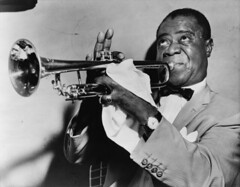
Louis Armstrong | Giants of Jazz Series
Originally uploaded by discoverblackheritage.
and
4. What is your favorite movie?

5. What kind of pets do you have?

6. Where do you live?

7. Where do you work?

DSC_0225
Originally uploaded by joaue.
8. Who do you look like?

9. What do you drive?
dollar rent a car
Originally uploaded by Atlantisa7.
10. What did you do on Saturday?

11. What did you do on Sunday?
traffic jam
Originally uploaded by K2D2vaca.
12. What is your favorite network TV Show?

Forgotten television
Originally uploaded by autowitch.
13. Describe Yourself.

14. What is your favorite candy?

Goo Goo Clusters
Originally uploaded by kamico.
20 May 2008
The best advice I ever got
...[I]f you had something good to say, you should put it in writing. But if you had something bad to say, you should tell the person to his or her face.The best advice I ever got (Fortune.com)
I learned this lesson the hard way. I'm chairman of the Whitney Museum of American Art in New York, and several years ago, I was angry with one of my trustees. I wrote a letter and signed it. But then I decided not to send the letter, and left it on my desk over the weekend. The following Monday I was out of the office, when a temp saw the letter and mailed it. The trustee got very angry and resigned from the board. To this day, writing that letter is something that I regret.
16 May 2008
Unhappy X'ers
The View From Harvard Business: Gen X Is Unhappy At WorkWorkers in their 30s and early 40s, otherwise known as Generation X, are growing unhappy with corporate life and planning a retreat, says Tammy Erickson, an expert on generational work force issues.
That’s bad news for their employers, who are looking to this cohort as next generation leaders.
Why are the Xers so cross? In her blog, Erickson provides 10 possible answers.
See Tammy Erickson's original post here: 10 Reasons Gen X'ers Are Unhappy At Work
14 May 2008
NPR's China Coverage
But some things are still best conveyed by radio. It can be a tremendous medium for storytelling.
National Public Radio ran a story on the quake's aftermath this afternoon that, well, completely tore me up. It took me quite a while to recover from it.
Melissa Block, on the ground in China, accompanied survivors as they frantically clawed through the rubble of their collapsed apartment building, looking for their loved ones.
The story is about 12 minutes long, and is so evocative of the horror on the ground that it is, candidly, really hard to take... but it's also one of the best pieces of radio journalism I think I've ever heard.
The ordinarily stalwart Ms. Block was not keeping it together all that well at points, and I have to say I was right there with her... the hell with journalistic (or personal) detachment in a situation like this.
The Scots-Irish, and how they vote
It's widely accepted that Hillary Clinton does better with older voters, less educated voters and white voters. These demographics perfectly match West Virginia -- and, more loosely, the entire Appalachian region. A few key points from tonight's exit polls demonstrate the point: 4 out of 10 voters were over 60 years of age. 7 out of 10 lacked a college degree -- the highest proportion of any electorate in the country. And 95% of the electorate was white.Basically you have a state that is made up almost exclusively of Clinton's voters. But there's a deeper historical explanation that we have to apply as well -- one nicely illustrated by the origins of West Virginia itself.
12 May 2008
Snark of the day
Wait until they find out that this novel is actually a memoir.
The only man Carter could beat
A worried conservative at American Thinker spells out his concerns in unusually plain language... in terms of personal charisma and likability, he might be FDR, JFK and RWR rolled into one:
Sensible McCain supporters need to begin this struggle with the following painful acknowledgement: on a personal level Barack Obama is one of the most ingratiating, likeable, least threatening, and intelligent-seeming men to run for the Presidency in the last hundred years.
There. Though I would no more vote for him than for Robespierre, I said it. It is a fact of consequence that needs to be faced.
In personal gifts relevant to political success, only three Americans during the twentieth century merit mention with Obama: Roosevelt, Kennedy and Reagan. This trio, as the historically well-schooled will recall, shared not only great political talent, but a common destiny: they all won.
So let's have no more talk of how much obviously weaker an opponent Obama is than what's-her-name. He is formidable enough, particularly for the execrable circumstances we confront.
[...]
A bit of history that seems relevant to the present situation: In 1980, back when communication was effected through messages chipped into stone tablets carried by horses, Ronald Reagan ran for the presidency against an incumbent named Carter. Carter enthusiasts breathed a collective sigh of relief when the Republican nomination was settled. They all knew their man was in trouble, but what luck! The Republicans had nominated an out-of-the-mainstream right wing extremist! The only man Carter could beat! Reagan's overall world view in fact was probably somewhat to the right of most Americans'. But in the event, Reagan won in a landslide, tremendously assisted by his ingratiating manner. There's more, of course, to why he won, but no one would dispute the importance of his manner.
10 May 2008
A good restaurant
You Guys Are Like the Gay Abbott and Costellovia Overheard in New York, May 10, 2008
[Heading towards the restaurant "Good".]
Gay guy #1: Where are we going again?
Gay guy #2: It's "Good".
Gay guy #1: What's good?
Gay guy #2: The name of the restaurant we're going to.
Gay guy #1: I asked you what it was.
Gay guy #3: Oh, we are so not doing this...
--The Village
(Good is a neighborhood place around the corner from us... and it really is. Good, I mean.)
Macs in suits
Millions of consumers are seeing the Mac in a new light. Once an object of devotion for students and artists, the Mac is becoming the first choice of many. Surging demand for the machines led Apple to predict revenues will rise 33% in the second quarter, to $7.2 billion, even in the face of an economic slowdown.
What's less obvious is that the enthusiasm is starting to spill over into the corporate market. It's a people's revolution, of sorts, with workers increasingly pressing their employers to let them use Macs in the office. In a survey of 250 diverse companies that has yet to be released, the market research firm Yankee Group found that 87% now have at least some Apple computers in their offices, up from 48% two years ago. "There's always been this archipelago of Macintosh use" among graphic artists and advertising managers, says Scott Teissler, chief information officer of Turner Broadcasting System (TWX). "My sense is that CIOs are more willing to see that expand without putting up as much resistance as in the past."
[...]
Mark Slaga, chief information officer of Dimension Data , a large computer services firm based in suburban Johannesburg, says he has received 25 e-mails recently from employees who want permission to use Macs at work. So far he has refused, because he doesn't want to hire people to provide Mac tech support, but "it'll happen someday," he concedes. "Steve Jobs doesn't need a sales force because he already has one: employees like the ones in my company."
BusinessWeek: The Mac In The Grey Flannel Suit (12 May 2008)
09 May 2008
It's not America, it's an island off the coast of America
Lawyers for Mayor Bloomberg are asking a judge to ban any reference to the Second Amendment during the upcoming trial of a gun shop owner who was sued by the city. While trials are often tightly choreographed, with lawyers routinely instructed to not tell certain facts to a jury, a gag order on a section of the Constitution would be an oddity.Gag on 2nd Amendment is City's Aim in Guns Suit (NY Sun, 9 May 2008)
08 May 2008
The Big Mac Index
A survey done by The Economist that determines what a country's exchange rate would have to be for a Big Mac in that country to cost the same as it does in the United States. Purchase power parity (PPP) is the theory that currencies adjust according to changes in their purchasing power. With the Big Mac PPP, purchasing power is reflected by the price of a McDonald's Big Mac in a particular country. The measure gives an impression of how overvalued or undervalued a currency is.
The calculation of the Big Mac PPP-adjusted exchange rate looks at the price of a Big Mac in a given country and divides it by the price of a U.S. Big Mac. Let's say that we are looking at the Big Mac in China. If a Chinese Big Mac is 10.41 renminbi (RMB) and the U.S. price is $2.90, then - according to PPP - the exchange rate should be 3.59 RMB for US$1. However, if the RMB was actually trading in the currency market at 8.27 RMB for US$1, the Big Mac PPP would suggest that the rmb is undervalued.
07 May 2008
Ex-LAX
Dear Barry Campbell,JetBlue really wanted me to get this message. They sent some variation of it to me five times... and then there was no way to re-route this flight via their web site; had to talk to a customer service rep.
Due to the unprecedented rise in the cost of jet fuel, JetBlue will not be starting service from Los Angeles International (LAX) May 21st as previously announced. We sincerely apologize for the disruption to your travel plans and we hope that you understand this difficult decision. We have taken the liberty of rebooking your flights to and from Long Beach, CA. Your new itinerary is detailed below.
Your flight... on [REDACTED], departing New York, NY (JFK) and arriving in Los Angeles, CA (LAX) has been cancelled.
You are now confirmed on flight... on [REDACTED], now departing New York, NY (JFK) at... and arriving in Long Beach, CA (LGB)...
In their defense, I have to say that the customer service agent I spoke to answered right away, was mighty nice, and was more than willing to re-route us to and from Burbank, California as opposed to Long Beach.
So we're still gonna make it to that wedding at the end of the month.
This could give new depth of meaning to "dead spots" in cellular coverage zones
Let's say the critical indicators you're measuring are a human being's "vital signs" (respirations, heart rate, blood pressure, etc.)
We've done this for race-car drivers, pilots, and astronauts for many years now, and equipment that does this kind of thing in a medical crisis is on the back of many (if not most, by now) ambulances. Smart defibrillators, which "interpret" a person's EKG and administer an electric shock to stop dangerous arrhythmias, can be found in mall food courts these days - or you can buy one for your home or office at Amazon.com for roughly the same cost as a Macbook.
Now, consumer-level medical telemetry appliances are about to proliferate. Although I hope for many more years of relatively good health, I am hopeful that when the time comes, I will be able to be fitted out with the nth generation of this gear:
The Bluetooth wireless technology that allows people to use a hands-free earpiece while making a mobile telephone call could soon alert the emergency services when someone has a heart attack, Ofcom predicts.
The communications regulator said that sensors could be implanted into people at risk of heart attack or diabetic collapse that would allow doctors to monitor them remotely.
If the “in-body network” recorded that the person had suddenly collapsed, it would send an alert, via a nearby base station at their home, to a surgery or hospital.
New wi-fi devices warn doctors of heart attacks (Times Online, 7 May 2008)
04 May 2008
Maureen Dowd, having none of it, thank you
Then came the Big Dog, crazy like a fox, for the coup de graceless. Campaigning in Clarksburg, W. Va., he said that his scrappy wife can win working-class voters, as compared with Obama’s Viognier-and-Volvo set.
“The great divide in this country is not by race or even income, it’s by those who think they are better than everyone else and think they should play by a different set of rules,” the former president said. “In West Virginia and Arkansas, we know that when we see it.”
Oh, well, at least Bill didn’t use the word uppity. And don’t you love this paean to rules coming from a man so tethered and humbled by rules that he invented an entirely new sexual etiquette to suit his needs in the Oval Office?
"This Bud's For You" (Maureen Dowd, New York Times, 4 May 2008)
02 May 2008
Question of the day
30 April 2008
Investing and chewing gum at the same time
Warren Buffett, the world's richest person, said on Monday the U.S. economy is in a recession that will be more severe than most people expect.
Buffett made his comments on CNBC television after his Berkshire Hathaway Inc agreed to invest $6.5 billion in the takeover of chewing gum maker Wm Wrigley Jr Co by Mars Inc in a $23 billion transaction.
"This is not a field of specialty for me, but my general feeling is that the recession will be longer and deeper than most people think," Buffett said. "This will not be short and shallow.
"I think consumers are feeling gas and food prices," he added, "and not feeling they've got a lot of money for other things."
A screen that ships without a mouse ships broken
Clay Shirky: Gin, Television and Social Surplus (HereComesEverybody.org)I was having dinner with a group of friends about a month ago, and one of them was talking about sitting with his four-year-old daughter watching a DVD. And in the middle of the movie, apropos nothing, she jumps up off the couch and runs around behind the screen. That seems like a cute moment. Maybe she's going back there to see if Dora is really back there or whatever. But that wasn't what she was doing. She started rooting around in the cables. And her dad said, "What you doing?" And she stuck her head out from behind the screen and said, "Looking for the mouse."
Here's something four-year-olds know: A screen that ships without a mouse ships broken. Here's something four-year-olds know: Media that's targeted at you but doesn't include you may not be worth sitting still for. Those are things that make me believe that this is a one-way change. Because four year olds, the people who are soaking most deeply in the current environment, who won't have to go through the trauma that I have to go through of trying to unlearn a childhood spent watching Gilligan's Island, they just assume that media includes consuming, producing and sharing.
Nah, no way this is going to be abused
Microsoft has developed a small plug-in device that investigators can use to quickly extract forensic data from computers that may have been used in crimes.Seattle Times: Microsoft device helps police pluck evidence from cyberscene of crime
The COFEE, which stands for Computer Online Forensic Evidence Extractor, is a USB "thumb drive" that was quietly distributed to a handful of law-enforcement agencies last June. Microsoft General Counsel Brad Smith described its use to the 350 law-enforcement experts attending a company conference Monday.
The device contains 150 commands that can dramatically cut the time it takes to gather digital evidence, which is becoming more important in real-world crime, as well as cybercrime. It can decrypt passwords and analyze a computer's Internet activity, as well as data stored in the computer.
It also eliminates the need to seize a computer itself, which typically involves disconnecting from a network, turning off the power and potentially losing data. Instead, the investigator can scan for evidence on site.
Why anyone with more than a passing interest in the security of their information would use Microsoft products in the first place is sort of beyond me.
I wonder how many of these little USB drives have gone missing or been copied since the initiation of the COFEE program... and I wonder what the inevitable follow-on DONUT program is going to do. (Talk about pandering to your audience.)
Note to self: leave the monkey at home
George Atterbury, General Manager of Grayz restaurant, interviewed in Eater's "The Gatekeepers" seriesWhat's the most outrageous request from a customer that you couldn't accommodate?
A customer wanted to dine with their pet monkey in the restaurant. Literally we had a guest walk into the restaurant hand in hand with a monkey and asked to be seated at the best possible table. I have been witness to a lot of different requests since coming form the Modern but that definitely has topped any request. The monkey was even wearing a little Burberry jacket.
29 April 2008
A pointy stick and an idea
Jim Denevan makes freehand drawings in sand. At low tide on wide beaches Jim searches the shore for a wave tossed stick. After finding a good stick and composing himself in the near and far environment Jim draws-- laboring up to 7 hours and walking as many as 30 miles. The resulting sand drawing is made entirely freehand w/ no measuring aids whatsoever. From the ground, these drawn environments are experienced as places. Places to explore and be, and to see relation and distance. For a time these tangible specific places exist in the indeterminate environment of ocean shore. From high above the marks are seen as isolated phenomena, much like clouds, rivers or buildings. Soon after Jim's motions and marks are completed water moves over and through, leaving nothing.I'm still getting over the fact that the man just walks out on the beach with a pointy stick in his hand and an idea in his head and makes beautiful, large-scale art... that is destined to go away at high tide.
I'd like to grab a copy of every photo on his site and post them here, but that would be rude, and also it would deprive you of the fun of checking them out yourself.
28 April 2008
If MSFT gets hostile
I have not seen a detailed analysis of how a full hostile takeover might play out -- the kind of analysis that you would be receiving if you were a Microsoft or Yahoo board member.
So I asked a pair of expert corporate attorneys -- Michael Sullivan and Ed Deibert at Howard Rice Nemerovski Canady Falk and Rabkin in San Francisco -- to work up such an analysis. What follows is their take blended with my commentary.
The list is life
April 28 (Bloomberg) -- Barack Obama's supporters are giving him more than just record amounts of cash. They also are providing personal information that may make his donor list the most powerful tool in U.S. politics.Bloomberg News: Obama's "Gigantic" Database May Make Him Party's Power Broker
Even if the Democratic presidential candidate doesn't succeed in his White House bid, this data will make Obama a power broker in the party for years to come. For the interest groups or Democratic candidates he chooses to sell it to, it would provide a gold mine of information and access to potential donors.
Almost 2 million people have entered personal information on Obama pages on social-networking Web sites such as Facebook, MySpace and his campaign's mybarackobama.com, offering home addresses, phone numbers, their views on specific issues and the names of friends. The data have allowed Obama, 46, to raise more than $200 million, fill sports arenas with supporters across the nation and motivate millions more with custom-tailored messages.
"It's gigantic," said Laura Quinn, chief executive officer of Catalist, a company that maintains a database of 280 million Americans. The list is as "transformational" as the advent of political advertising, she said.
27 April 2008
Parts of the story we're not hearing
If we’ve learned any new rule in the 2008 campaign, it’s this: Once our news culture sets a story in stone, chances are it will crumble. But first it must be recycled louder and louder 24/7, as if sheer repetition will transmute conventional wisdom into reality.How McCain Lost Pennsylvania (Frank Rich, New York Times, 27 April 2008)When the Pennsylvania returns rained down Tuesday night, the narrative became clear fast. The Democrats’ exit polls spelled disaster: Some 25 percent of the primary voters said they would defect to Mr. McCain or not vote at all if Barack Obama were the nominee. How could the party possibly survive this bitter, perhaps race-based civil war?
But as the doomsday alarm grew shrill, few noticed that on this same day in Pennsylvania, 27 percent of Republican primary voters didn’t just tell pollsters they would defect from their party’s standard-bearer; they went to the polls, gas prices be damned, to vote against Mr. McCain. Though ignored by every channel I surfed, there actually was a G.O.P. primary on Tuesday, open only to registered Republicans. And while it was superfluous in determining that party’s nominee, 220,000 Pennsylvania Republicans (out of their total turnout of 807,000) were moved to cast ballots for Mike Huckabee or, more numerously, Ron Paul. That’s more voters than the margin (215,000) that separated Hillary Clinton and Mr. Obama.
Those antiwar Paul voters are all potential defectors to the Democrats in November. Mr. Huckabee’s religious conservatives, who rejected Mr. McCain throughout the primary season, might also bolt or stay home. Given that the Democratic ticket beat Bush-Cheney in Pennsylvania by 205,000 votes in 2000 and 144,000 votes in 2004, these are 220,000 voters the G.O.P. can ill-afford to lose.
26 April 2008
Knowledge that you can use
Tomorrow --Wood-Chippers and Car Trunks!
Student: So how can we use this information to our advantage?
via Overheard in New York, Apr 26, 2008
Professor: Well, if you were ever going to kill someone you would want to bury them in wet ground.
Student: Like a swamp?
Professor, with evil grin: A swamp would be ideal.
--Electromagnetics Lecture, Columbia University
Ribbing
The ribs were so good, that I was using Wildwood's ribs to teach my daughter how competition barbecue is judged. A RESTAURANT RIB. If you've never judged a barbecue contest, you don't understand how rare it is to get ribs of this quality in restaurants. The meat came off the bone only where bitten. The rib sweated lightly where the meat was removed. You could taste the meat and the seasonings and they actually complimented each other!-- The proprietor of White Trash BBQ waxes ecstatic about Wildwood, the latest restaurant entry in New York City's barbecue joint explosion.
25 April 2008
The mean streets of Norwalk and Darien
Hell Hath No Fury Like Wednesday One-Liners
Preacher: We've got a lot of tourists here today and we know why you came -you want to see a black gospel church. And that's okay, that's okay! That's what we are. And you know, some of our members, they do it tough. Why, they come from such rough neighbourhoods as Connecticut and upstate New York ...
--Abyssinian Baptist Church, Harlem
via Overheard in New York, Apr 23, 2008
23 April 2008
How to lose a sure thing
Coverage of this election cycle has been generally awful, and with rare exceptions (see: David Gergen) last night on CNN was more of the same.
There's just not enough to talk about to fill the hours of airtime on a 24/7 cable news channel, so that's a guaranteed font of babbling vacuity... but with the newspaper business in deep malaise and decline, the journalists who used to turn out crisp reporting and analysis on deadline seem to be missing in action.
So.
Hillary came within six tenths of a point of getting the 10 point victory she needed to "stay alive" in the primary... when you're virtually eliminated mathematically from being selected as the nominee, I'm not sure what kind of life it is, but she's still in it.
Last fall, if you had presented me with *any* scenario in which the Republicans won the White House in November, I'd have dismissed you as a fantasist or a paranoid, depending on your point of origin on the political spectrum.
I did allow at the time, however, that if any political party could figure out a way to lose a sure thing, it would be the Democrats.
Damned if they aren't working on it.
This bitter, brutal, and fratricidal primary looks to continue for several more weeks, if Hillary can raise enough money on the strength of her showing last night. And if enough bitterness is engendered between and among Clinton and Obama partisans, that could be the margin of defeat for the Democrats in November, right there.
John McCain must not be able to believe his luck.
21 April 2008
AngryRenter.com
All we hear these days is whining from reckless home borrowers and their banks.
But did you know that renters are 32 percent of American households? And that homes in foreclosure are less than 2 percent?
So why is Congress rushing to bailout high-flying borrowers and their lenders with our tax dollars?
Unfortunately, renters aren't as good at politics as the small minority of homeowners (and their bankers) who are in trouble. We don't have lobbyists in Washington, DC. We don't get a tax deduction for our rent and we don't get sweetheart government loans.
Quite simply, we are just Angry Renters. And now it is our time to be heard: no government bailouts!
Kevin Phillips: Why the economy is worse than we know
But on impulse, I picked up a copy in the airport over the weekend. There's a terrific article by Kevin Phillips in the May 2008 issue (not available online unless you're a subscriber.) This will give you the flavor of it:
The truth, though it would not exactly set Americans free, would at least open a window to wider economic and political understanding. Readers should ask themselves how much angrier the electorate might be if the media, over the past five years, had been citing 8 percent unemployment (instead of 5 percent), 5 percent inflation (instead of 2 percent), and average annual growth in the 1 percent range (instead of the 3-4 percent range). We might ponder as well who profits from a low-growth US economy hidden under statistical camouflage. Might it be Washington politicos and affluent elites, anxious to mislead voters, coddle the financial markets, and tamp down expensive cost-of-living increases for wages and pensions?(excerpt from "Numbers Racket: Why the economy is worse than we know" by Kevin Phillips, from the May 2008 issue of Harper's Magazine)
Let me stipulate: the deception arose gradually, at no stage stemming from any concerted or cynical scheme. There was no grand conspiracy, just accumulating opportunisms. As we will see, the political blame for the slow, piecemeal distortion is bipartisan--both Democratic and Republican administrations had a hand in the abetting of political dishonesty, reckless debt, and a casino-like financial sector. To see how, we must revisit forty years of economic and statistical dissembling.
[...]
The real numbers, to most economically minded Americans, would be a face full of cold water. Based on the criteria in place a quarter-century ago, today's U.S. unemployment rate is somewhere between 9 percent and 12 percent; the inflation rate is as high as 7 or even 10 percent; economic growth since the recession of 2001 has been mediocre, despite a huge surge in the wealth and incomes of the superrich, and we are falling back into recession. If what we have been sold in recent years has been delusional "Pollyanna Creep," what we really need today is a picture of our economy ex-distortion. For what it would reveal is a nation in deep difficulty not just domestically but globally.
20 April 2008
We're going to need an environmental impact statement on those ashes
Green Funerals Make For Eco-Exits (Associated Press via Yahoo, 20 April 2008)Britain has been a world leader in eco-friendly funerals for years and a source of green burial products and ideas for countries like the United States, where the trend is just starting to catch on. Over the weekend in London, those in the business showcased their products and services at the Natural Death Center's Green Funeral Exhibition.
Some may expect green funerals to be as cheap as a do-it-yourself project, while others might brace for price hikes similar to those fair trade food.
But, funeral directors say green funerals — like any — run the gamut.
"It's about choice, not price," said Fran Hall, marketing director for Epping Forest Burial Park.
For a concept aimed at saving the Earth by going back to basics, an eco-funeral can be more complicated than it sounds. The Natural Death Center provides a handbook that suggests environmental targets for cemeteries.
"You can take any funeral and make it greener," said Michael Jarvis, the center's director.
Tribal logic
Arab tribesmen are preoccupied with maintaining deterrence and prepared to use force preemptively, if necessary--rather like über neocons. The ironic but very real parallel is a function of the de facto stateless anarchy in which Arab Bedouin live--and the de facto global anarchy that hawkish conservatives rightly believe to be the underlying reality of the international system. Saddam Hussein's interest in being taken to possess WMDs, whether or not he actually had them, makes sense in light of the link between deterrence and reputation. The emboldening effects of America's pre-9/11 retreats in Somalia, Lebanon, and elsewhere show the reverse of the medal. Although this is a familiar litany, I'd argue that the fatwa against Salman Rushdie, the rage against the Muhammad cartoons, the killing of Theo van Gogh, and a host of related acts of intimidation ought to be placed under the heading of pro-active deterrence as well."I and My Brother Against My Cousin" - Stanley Kurtz reviews Philip Carl Salzman's Culture and Conflict in the Middle East in The Weekly Standard
The swift and seemingly disproportionate resort to retaliatory force against apparently trivial offenses is an effective technique for suppressing future challenges. Most of the feuds Salzman describes, however weighty and enduring, break out over seemingly petty and inconsequential matters, like the mistaken appropriation of some palm trunks. Rifle shots, intentionally off the mark, are used to intimidate, as are calculated threats of murder. The careful use of targeted force and credible threats against Western critics of Islamism shows genuine mastery of the technique of deterrent intimidation. Here as elsewhere, an overtly religious action is actually shaped by a hidden tribal template.
Knowingly or unknowingly, American liberals and conservatives highlight sections of the tribal template, though for their own preferred uses. The implicit dovish take on tribalism notes that our own use of force actually serves to unite the foe. By hitting back at terrorist-harboring states, doves remind us, we create the impression of an infidel war against Muslims, thus figuratively recruiting every Muslim lineage into bin Laden's civilizational war party. This danger is real, yet the doves omit the rest. Failure to strike back creates an impression of weakness that invites further attacks.
18 April 2008
The prepubescent Shaolin monks of Apex, NC
But that's not what I'm here to talk about.
I'm here to talk about weirdness.
As a resident of NYC for these last 12 years, I've seen some wonderfully bizarre things. I still cherish the memory of the day I saw a local performance artist peddling down West 4th Street on an elevated tricycle, towing a full-sized concert harp behind her on an attached trailer.
As a connoisseur of weirdness, I have to say: that was prime.
But as I pulled into the parking lot of the restaurant in Apex, I saw something equally wonderful.
A large area of the parking lot was roped off, and there were dozens of small children in karategis, shouting, grunting, and whacking at each other with bō staffs. The sensei was instructing and encouraging them, and I'd swear on a stack of Bibles that at one point, he urged his young charges, "Go with God!"
Any way you parse it, this is great stuff.
Thought for the day
Whatever else happens the next time we choose a president, there has got to be a better way to see candidates operate under pressure than the grotesque system that has metastasized during this electoral cycle. It makes candidates into mere props for bullying anchormen-narcissists. It does no one except the anchormen any good. I mentioned earlier the oddity of Jimmy Carter and GW Bush finding common cause about China policy. Maybe the RNC and the DNC can join hands in freeing political debate from the destructive grip of the networks. And if they can't do that, maybe we should just go all the way and have the candidates compete eating pails full of maggots on Fear Factor. That's the logical extension of where we're headed.Sorry if you read this before breakfast, but the man has a point.
17 April 2008
Words fail me
People are too trusting, especially when there’s chocolate on the line.Security is No Match for Chocolate and Good Looking Women (WSJ Technology Blog)
A survey out today by the organizers of the tech-security conference Infosecurity Europe found that 21% of 576 London office workers stopped on the street were willing to share their computer passwords with a good looking woman holding a clipboard. People were offered a chocolate bar in exchange for the information. More than half of the people surveyed said they used the same password for everything.
"Attractive woman holding clipboard and offering chocolate" works on men *and* women, by the way:
61% of workers surveyed shared their birthdates and a similar number – 60% of men and 62% of women – shared their names and telephone numbers.Come on, kids. Let's be safe out there. Resist the siren song of Cadbury Dairy Milk, don't use the same password for everything, and for God's sake don't share personal information with strangers, even (especially!) hotties "taking surveys."
15 April 2008
Tax day musings
But when I read a story like this, I sometimes reflect that it's a good thing we're not getting all the government we're paying for.
12 April 2008
This is so the name of my heavy metal cover band
...German settlers in Texas would often refer to the armadillo as Panzerschwein ("armored pig").Wikipedia article on armadillos
Ladies and gentlemen, Panzerschwein.
The 50 Greatest Comedy Sketches of All Time
The highbrow cinemaphiles at IFC and the brainy sex kittens at Nerve have combined resources to write their Top 50 list for television sketch comedy:
There's no more sure-fire way to kill something's intrinsic comedic value than to try to examine what makes it funny. The minute you start thinking, you stop laughing. So why, then, have Nerve and IFC.com devoted an enormous amount of time, manpower, monetary resources, server space and posh catered lunches to the pursuit of ranking the boob tube's finest sketch comedy offerings?This list is a lot of fun.
In part, we're here because magical new technology (*coughYouTubecough*) allows us to do more than just pontificate for paragraphs on end — now we can pontificate for paragraphs on end and provide audio-visual evidence to back up those pontifications. We provide the context, share our thoughts and feelings and let you commence with the guffawing and, naturally, the disagreeing. After all, the comedy sketch — short, sweet, completely silly or shot through with social commentary — worms its way into the public mind like nothing else, and has easily made the leap to the web when other forms have faltered.
IFC: 50 Greatest Comedy Sketches
Nerve: 50 Greatest Comedy Sketches
Microhoo. Yahsoft. No, keep at it...
Microsoft makes a ton of revenue on sales of software that sit on the computer. $15 billion a year for Windows alone, and another $16 billion for Office and Exchange Server in 2007TechCrunch: Gartner Says Vista Will Collapse. And That's Why The Yahoo Deal Must Happen. (11 April 2008). That’s 60% of Microsoft’s total revenue, and profits from those groups float the rest of the company. Microsoft isn’t a viable company without their consumer and business desktop software profits.
The real question isn’t “What can Microsoft do to fix their Windows product?” but rather “Even If Windows and Office were perfect, would it be enough to keep Microsoft relevant in the medium term?” I think the answer to that latter question might be “nope.” And that, of course, is why they want Yahoo so badly. Online advertising revenue is their only real hope of long term survival.
On prancer, on dancer
...Jagger's voice has become monotonous. It is impossible not to have some doubts about a 63-year-old--however flat his stomach, however mini his hips--rustling up musical energies (if not from beyond the grave exactly, then) from a time long before punk. It is as if he is caricaturing himself from some dreadful late 1960s TV variety show. Even then, he was much more of a prancer than dancer.James Woodall, "Watching 'Shine A Light'" (More Intelligent Life)Still, the old hits are here--"Jumping Jack Flash", "Sympathy for the Devil", "Brown Sugar". The best moments are when the band is joined by Buddy Guy, a brilliant old blues man, for a rendition of "Champagne and Reefer", and when Jagger slings a white electric guitar over his shoulder to join his two guitar regulars for a thrumming, visceral "Some Girls".
Both numbers point up the band's elemental strengths: their lashing blues base and their essential structure as a guitar band (just watch those three budding pensioners axe away in "Some Girls"). Rock'n'roll gets neither longer in the tooth nor more basic than this.
11 April 2008
A hell of a town
Which Speaker You Find More Annoying Says a Lot About You as a Person
Environmentalist with clipboard: Excuse me, do you have a minute to help save the environment?
Woman in suit: I'm sorry, I already saved the children this morning and then told the Democratic Party to go fuck themselves three blocks ago, so no, I don't have time to save the environment today. Maybe tomorrow, hippie.
--Broadway & Bond
Overheard by: Betty Noir
via Overheard in New York, Apr 11, 2008
Whine connoisseur
Whining, White Smoke & The Mechanics Of Getting Unstuck (43 Folders)First off, even when it’s yourself, nobody likes a whiner. So it’s worthwhile to be mindful about the extent to which your internal monologue is becoming personally insufferable. As with B.O. and a lack of flossing, the chances are good that others have already noticed things about you before you have, so — you know — congratulations on making it to the party.
But, second, and perhaps more importantly, that whining should be telling you something. Whining is the white smoke in your tailpipe that lets you know you’re burning mental oil. It means you’re unconsciously devoting cycles to something that you can’t, won’t, or shouldn’t be spending time thinking about. Otherwise, why would it be bothering you, right? You’d be either extricated or done with it.
Once you pinpoint where that whine’s coming from, that’s the perfect opportunity to decide what the hell the hang-up is. Because if it’s worth whining and fussing about, it’s worth deciding what obstacle (obstruction?) in either the Real World or your own mind is keeping something from happening.
In the days we sweat it out in the halls of the New York Armory Show
Bruce Springsteen and the E Street Band had just finished playing a sold-out show at Earls Court in London, and Max Weinberg, the band's longtime drummer, was thinking about countertops.Born To Renovate (Wall Street Journal, 11 April 2008)
Specifically, Kirkstone countertops. Mr. Weinberg wanted the pale green stone for the kitchen in the house he was building back in New Jersey. He knew the stone came from England, and he noted a kitchen-supply store they passed on the way back from the concert. The next day, the store's manager told him that it didn't stock the material but suggested he try the Kirkstone showroom nearby. Mr. Weinberg paid a visit and had the stone shipped across the Atlantic.
We all grow older and grow up, I reckon.
08 April 2008
Perception of the doors
Explanation here:
Hat tip: CarrieThere is no car behind Door 3, since the host opened it, so the last term must be zero. This can be proven using Bayes' theorem and the previous results:
Hence:
This shows that the winning strategy is to switch the selection to Door 2.
.

06 April 2008
"...and the last three stanzas of your life will purely suck."
Avoid navigable waterways. Don’t let yourself be talked into going down by the wild rippling water, the wan water, the salt sea shore, the strand, the lowlands low, the Burning Thames, and any area where the grass grows green on the banks of some pool. Cliffs overlooking navigable waterways aren’t safe either.
[...]
Going to sea to avoid marrying your sweetie is an option, but if she hangs herself after your departure (and it’s even money that she’s going to) her Doleful Ghost will arrive on board your ship and the last three stanzas of your life will purely suck.
If you are a young gentleman who had sex it is possible the girl won’t get pregnant. In those rare instances you will either get Saint Cynthia’s Fire or the Great Pox instead. No good will have come of it.
[...]
Professions to be particularly wary of: clerks, salty sailors, serving maids, blacksmiths, highwaymen, gamblers, rank robbers, stonemasons, soldiers, tinkers, and millers. Anyone described as “jolly,” “bold,” or “saucy.” Supernatural creatures are best avoided. If they can’t be avoided, they should be addressed respectfully. If a supernatural creature sets you a task you’re well and truly screwed.
We're not in Kansas anymore
UNC collapsed comprehensively in the first half, going into the locker room, unbelievably, almost thirty points down...and though they whittled the Kansas lead to four points briefly in the second half, Kansas led and essentially remained in control for the entire game.
The outcome was never really in doubt.
UNC had a great year. The played a very nearly perfect season and were dominant throughout the tourney.
I had been really looking forward to last night's game, because I expected that it would be the first time the Heels would really be challenged in the tournament.
Be careful what you wish for, I reckon. :-)
The next big news out of Carolina basketball is likely to be Tyler Hansbrough's decision about whether to turn pro.
04 April 2008
Disgruntled Bear Stearns investors are everywhere
I AM THE ONE OUT THERE ON THE STREET!via Overheard in New York, Apr 4, 2008Four-year-old girl screaming: IT IS MY MONEY AND I WANT IT BACK!
Shockingly calm but exhausted Dad: No Sarah, it is OUR money.
Sarah [chanting over and over while stomping her feet.]: IT IS MY MONEY! I WANT IT BACK!
--Bank, Madison Ave & E 65th
Overheard by: Christina
01 April 2008
Happy April Fool's Day!
Here's a personal favorite:
#5: San SerriffeIn 1977 the British newspaper The Guardian published a special seven-page supplement devoted to San Serriffe, a small republic located in the Indian Ocean consisting of several semi-colon-shaped islands. A series of articles affectionately described the geography and culture of this obscure nation. Its two main islands were named Upper Caisse and Lower Caisse. Its capital was Bodoni, and its leader was General Pica. The Guardian's phones rang all day as readers sought more information about the idyllic holiday spot. Few noticed that everything about the island was named after printer's terminology. The success of this hoax is widely credited with launching the enthusiasm for April Foolery that gripped the British tabloids in subsequent decades.